
Headworks and Primary Treatment
Hydrogen sulfide odor can be extremely toxic and flammable. Not to mention the invasive odor it emits to workers and the surrounding community. Attacking this colorless gas at the source is extremely important to the safety of your facility. Vapor or fan systems that are properly installed at the bar screens and digesters will solve any issues.
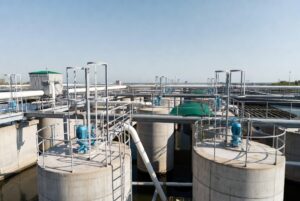
Wastewater Septage Dumping
Plants that have their industrial emissions under control may still need odor solutions for handling and transportation of raw septage. Fan or nozzle atomization systems installed near the unloading point where haulers bring septage, or downstream from this area, can provide effective odor removal.
Activated Sludge Basins
Basins holding activated sludge and wastewater are typically large, uncovered, and odor producing. Smells from these basins can freely drift with the wind into neighboring communities, leading to negative perception of your plant and potential fines.
Composting
Municipal sludge is often composted in indoor facilities or composting sheds. These areas create significant odor control challenges.
Composting material is rich in organic matter, making it valuable fertilizer. But the reuse of this material comes at a price. Transporting, storing, and processing decomposing material creates powerful malodors — often drifting into nearby residential areas and office parks.
Organics recycling facilities also manage the smelly process of decomposition. Proteins, carbohydrates, and fats from food scraps and other organic materials are broken down. At each stage of decay, gases are produced that emit foul odors.
Sludge Receiving and Storage
At many composting sites, odors come from incoming material. These ingredients may have been stored anaerobically (without oxygen) for a week or more before transport to the site. Once these ingredients are added, low oxygen conditions can compound odor issues.
Anaerobic odors include a range of compounds with their own challenges, including:
- Reduced sulfur compounds (hydrogen sulfide, dimethyl sulfide, dimethyl disulfide, and methanethiol)
- Volatile fatty acids
- Aromatic compounds
- Amines
- Ammonia
Why do wastewater treatment plants smell?
Many odors can be released from wastewater treatment plants. Commonly they are described as odors resembling rotten eggs, garlic, ammonia, or earthly smells. Odors that come from wastewater treatment plants are caused by the use of chemicals such as:
- Hydrogen sulfide (H2S)
- Sulfur dioxide
- Skatoles
- Indoles
- Amines
With so many different chemicals being the possible source of odor, a variety of odor control methods are often needed and recommended for a complete odor removal.
How to Use
Whenever possible, we use existing odor control hardware (e.g., scrubbers) to apply odor control solutions. In situations where there is no current system in place to control odors, our team designs system options.
Most facilities opt for vaporization systems, where ducting carries product in submicron form to the source of the odor, neutralizing it on contact. There are no nozzles to plug making this system virtually maintenance free.
Many systems are operated on an “as needed” basis, and switched on when the odor reaches a certain perceived level, while others kick on automatically based on wind direction, when air currents cause odors to travel toward neighboring businesses or residential developments.
For composting and solid waste: products can be evaporated or atomized with nozzles or fans to control industrial composting odors even in large facilities. It is also available in spray gel, which blocks odors from escaping into the atmosphere when added on top of composting material. Spray Gel is a special formulation that topically blocks odors from escaping into the atmosphere — an ideal solution for open-bed waste trucks, working face of compost piles, and other solid/semi-solid odorous materials.
As with most odors, composting smells get worse when moved. As compost rows are turned or solid waste is dumped, bad odors increase. Products can be used to control malodors, either in a localized area or to surround a large area such as a landfill or composting shed. Delivery systems can be integrated with facility hardware to control odors as they are released by machinery like graders and tillers.
ODOUR CONTROL PHILOSOPHY AND GOAL
The philosophy behind plant-based odour control is to provide a safe, sustainable, and effective alternative to traditional chemical methods by using natural, biodegradable formulations to neutralize odours at the molecular level. The primary goal is to eliminate malodours completely without introducing new toxins or harsh chemicals into the environment.
Core Philosophy
The plant-based odour control philosophy is guided by several key principles:
Environmental Responsibility: Utilizing ingredients derived from renewable botanical sources that are non-hazardous, non-toxic, and fully biodegradable. This approach avoids the environmental impact and potential secondary pollution associated with traditional methods.
Molecular Neutralization, Not Masking: Unlike masking agents that use strong fragrances to cover up smells, plant-based solutions are designed to chemically react with, absorb, or encapsulate the malodorous compounds, altering their molecular structure to render them odourless.
Safety and Health: Prioritizing the well-being of the public, employees, animals, and ecosystems. These solutions are safe for use in a variety of sensitive applications without requiring extensive personal protective equipment.
Source Treatment: The philosophy often extends to addressing the source of the odour, such as stimulating the aerobic degradation of organic waste by beneficial bacteria, which prevents the formation of odorous gases in the first place.
Key Goals
The implementation of plant-based odour control aims to achieve specific outcomes across various industrial and commercial applications:
Regulatory Compliance: Meeting or exceeding increasingly stringent environmental regulations and air quality standards set by governmental bodies.
Improved Community Relations and Brand Reputation: Eliminating nuisance odours to foster positive relationships with surrounding residential and business communities.
Enhanced Workplace Quality and Safety: Providing a healthier and more pleasant working environment.
Cost Efficiency and Operational Optimization: Offering a cost-effective alternative to traditional systems with high capital investment and energy demands.
Integration with Sustainability Goals (ESG): Aligning a facility’s operations with Environmental, Social, and Governance (ESG) principles.
CORE GOAL AND MISSION
The core goals of plant-based odour control revolve around providing effective, sustainable, and safe alternatives to traditional chemical methods, primarily by neutralizing malodorous compounds at their source using natural processes.
Core Goals
- Effective Odour Elimination: To completely eliminate odours by breaking down and neutralizing odour molecules rather than just masking them with fragrances.
- Environmental Responsibility: To offer a near-zero carbon footprint solution that preserves natural resources, protects biodiversity, and avoids the introduction of toxic or hazardous substances into the environment.
- Health and Safety: To create safer environments for employees, the public, and animals by using non-toxic, non-hazardous, and biodegradable formulations.
- Regulatory Compliance: To help facilities meet or exceed stringent environmental and workplace safety regulations regarding air quality and odour pollution.
- Cost Efficiency: To provide cost-effective solutions that reduce the significant capital investment and operational costs associated with conventional odour control infrastructure.
- Community Well-being: To improve the quality of life for neighboring communities and employees by mitigating odour nuisance.
CORE PRINCIPLES
The core principles of plant-based odor control focus on eliminating malodors at the molecular level, not just masking them with fragrances. This is achieved through a combination of physical and chemical mechanisms using plant-derived formulations, primarily essential oils and organic micronutrients.
The key principles are:
- Molecular Binding (Adsorption and Absorption): Plant-based formulas contain specific active compounds that physically bind to the surface of odor molecules (adsorption) and then encapsulate or dissolve them within atomized liquid droplets (absorption).
- Chemical Neutralization: Direct chemical reactions occur between the functional groups in plant essential oils and the malodorous compounds. This reaction transforms the odorous substance into non-volatile, odorless compounds, permanently deactivating the smell.
- Solubility Enhancement: Plant-based solutions, often applied as water emulsions with bio-based surfactants, significantly increase the solubility of odorous gases in the liquid phase.
- Biological Degradation Support: In some applications, plant-based products stimulate beneficial microbial activity to break down the underlying organic matter causing the odors.
- Prevention at the Source: The most effective strategy involves preventing the production of odorous compounds in the first place, often by applying the plant-based solutions directly to the source material to block odors from escaping or inhibiting the conditions that create them.
KEY ACTION STATEMENTS
The key action statement for plant-based odour control is to eliminate malodours at the source by utilizing natural, non-toxic formulations that neutralize and break down odour-causing organic matter and chemical compounds. This approach provides a safe, effective, and environmentally sustainable alternative to traditional chemical masking agents.
Key Action Principles
- Source Elimination, Not Masking: Plant-based solutions work through multiple mechanisms, including absorption, adsorption, and chemical reactions with malodorous molecules, converting them into non-odorous, non-volatile substances.
- Biological Stimulation: Certain plant-based micronutrient solutions stimulate the metabolic rates of beneficial microorganisms, which then outcompete odour-producing bacteria for food sources. This process of competitive inhibition prevents the generation of odours like hydrogen sulfide (H₂S) and ammonia (NH₃) from organic waste streams.
- Safety and Sustainability: These technologies are non-hazardous, non-toxic, and biodegradable, ensuring safety for employees, communities, and the environment.
- Versatile Application: Plant-based formulations can be applied in various ways depending on the source and environment, including atomized misting or vapor phase systems for airborne odours, or direct injection into liquid and solid waste streams.
Benefits of this Approach
- Improved Air Quality: Achieves genuine odour elimination, leading to a more pleasant working environment and fewer complaints from nearby residents.
- Regulatory Compliance: Helps facilities meet environmental regulations and avoid fines by proactively managing odour emissions.
- Cost Efficiency: Often results in lower operating costs and reduced maintenance requirements compared to chemical-intensive methods.